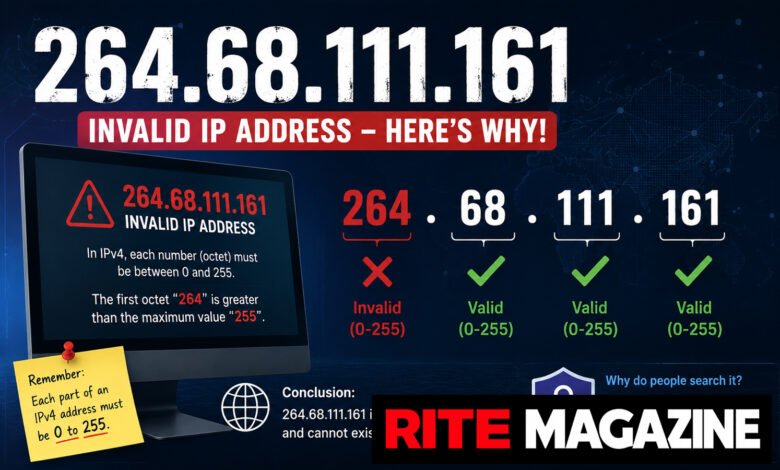
Have you ever come across the number 264.68.111.161 and wondered what it means? Maybe you saw it in a tech forum, a script, or someone sent it to you as an IP address. At first glance, it looks like a normal IP address. But here is the thing — it is not valid at all. In this article, we will explain why this number is not a real IP address, how IP addresses actually work, and what could happen if someone uses an invalid one by mistake.
What Is an IP Address?
Let us start with the basics. An IP address stands for Internet Protocol address. It is a number that is given to every device that connects to the internet or a network. Think of it like a home address — just like your home has a unique address so the postman can find you, your device has an IP address so data can find it on the internet.
There are two main types of IP addresses used today:
- IPv4 (Internet Protocol version 4): This is the older and most common format. It looks like four groups of numbers separated by dots, for example: 192.168.1.1
- IPv6 (Internet Protocol version 6): This is a newer format made to handle the growing number of devices on the internet. It looks much longer and uses both numbers and letters, like: 2001:0db8:85a3:0000:0000:8a2e:0370:7334
The IP address 264.68.111.161 is written in the IPv4 format. So let us focus on that.
How Does IPv4 Work?
An IPv4 address has four parts called octets. Each octet is a number between 0 and 255. The four octets are separated by dots (periods). Here is an example of a valid IPv4 address:
192.168.0.1
Each part of this address is within the range of 0 to 255. That is the rule. Always. No exceptions.
The reason the range is 0 to 255 is because each octet is made of 8 bits of binary data. In binary (the language computers use), 8 bits can hold values from 0 to 255. That is 256 possible values in total (including 0).
So any number above 255 in any of the four parts makes the entire IP address invalid.
Why Is 264.68.111.161 Not Valid?
Now let us look at 264.68.111.161 more closely.
| Octet | Value | Valid? |
|---|---|---|
| First | 264 | No — above 255 |
| Second | 68 | Yes |
| Third | 111 | Yes |
| Fourth | 161 | Yes |
The problem is simple. The first number is 264, which is greater than 255. This breaks the rule of IPv4 addressing. Because of this one number, the entire address becomes invalid and cannot be used on any network.
No device on the internet can have this address. No router will accept it. No computer will connect using it. It simply does not exist in the world of networking.
Could It Be a Typo?
One of the most common reasons people come across addresses like 264.68.111.161 is a simple typing mistake. Someone might have meant to type a different number but made an error. For example:
- They could have meant 164.68.111.161 (replacing 264 with 164)
- Or maybe 24.68.111.161 (dropping the extra digit)
Typos happen all the time, especially when copying long strings of numbers manually. If you received this address from someone and it does not work, the first thing to check is whether there was a typing error somewhere.
What Happens When You Use an Invalid IP Address?
If someone tries to use 264.68.111.161 in a browser, a server configuration, or a network tool, here is what will likely happen:
1. Browser Error If you type this into a web browser, you will get an error message. The browser will not be able to connect because the address does not follow the correct format. You might see something like “This site can’t be reached” or “Invalid address.”
2. Command Line Failure If a developer or network engineer tries to ping this address using the command line, the system will return an error saying the address is invalid or unreachable.
3. Application Crash or Error If a computer program tries to connect to this address without first checking if it is valid, the program could crash or show an error. Good software always validates IP addresses before using them.
4. Configuration Problems If someone puts this invalid address into a server or firewall setting, the setting will either be rejected or cause unexpected behavior in the system.
Why Does This Matter for Developers?
If you are a developer or someone who works with networks, understanding IP address validation is very important. Here is why:
Security: Invalid IP addresses in your system’s logs can sometimes point to scanning attacks or broken tools being used by bad actors trying to probe your network.
Debugging: When something goes wrong with a network connection, checking whether the IP address is valid is one of the first steps in troubleshooting.
Data Validation: If your application accepts IP addresses as input (for example, in a form), you need to make sure it checks that the address is valid before using it. Accepting invalid data can cause bugs and security issues.
Most programming languages have built-in tools or libraries to check if an IP address is valid. For example:
- In Python, you can use the
ipaddressmodule - In JavaScript, you can write a simple regular expression or use a library
- In Java, the
InetAddressclass can help
These tools would immediately flag 264.68.111.161 as invalid.
The Range of Valid IPv4 Addresses
To understand this better, here is a quick overview of the full range of valid IPv4 addresses:
- Smallest valid address: 0.0.0.0
- Largest valid address: 255.255.255.255
That means there are about 4.3 billion possible IPv4 addresses in total. While that sounds like a lot, the world actually ran out of available public IPv4 addresses around 2011. That is one of the reasons IPv6 was created, which supports a practically unlimited number of addresses.
Some IP address ranges have special purposes:
| IP Range | Purpose |
|---|---|
| 10.0.0.0 to 10.255.255.255 | Private network (home/office) |
| 172.16.0.0 to 172.31.255.255 | Private network |
| 192.168.0.0 to 192.168.255.255 | Private network (most common home use) |
| 127.0.0.0 to 127.255.255.255 | Loopback (your own device) |
| 0.0.0.0 | Non-routable (used as a placeholder) |
| 255.255.255.255 | Broadcast address |
None of these ranges include anything starting with 264, because that number is already outside the valid limit.
How to Check if an IP Address Is Valid
If you want to quickly check whether an IP address is valid, here are a few easy ways:
Method 1: Check Each Octet Manually Split the address by dots and check that each part is a number between 0 and 255. For 264.68.111.161, the first number (264) is already above 255, so it fails.
Method 2: Use an Online Tool There are many free IP address checker websites where you can paste an address and it will tell you if it is valid or not.
Method 3: Use a Programming Language As mentioned earlier, most modern programming languages have simple ways to validate IP addresses. A quick search for “IP address validation in [your language]” will give you ready-to-use code.
Is There Any Chance 264.68.111.161 Could Be Valid in the Future?
In short, no. The rules of IPv4 are fixed. The maximum value for each octet will always be 255. This is not going to change because it is based on how binary numbers work at a very basic level.
However, if the internet ever fully moves to IPv6, the format changes completely. IPv6 does not use the same four-number structure. But even in IPv6, the address 264.68.111.161 would not make sense because IPv6 uses a completely different format with colons and hexadecimal numbers.
So in no current or future standard is 264.68.111.161 a valid address.
Key Takeaways
Let us summarize the most important points from this article:
- An IPv4 address has four numbers separated by dots
- Each number must be between 0 and 255
- 264.68.111.161 is invalid because 264 is greater than 255
- It cannot be used to connect to any device or service on the internet
- It is likely the result of a typo or a mistake in data entry
- Developers should always validate IP addresses before using them in applications
Understanding these basics helps you avoid errors when working with networks, writing software, or troubleshooting connection issues.
Frequently Asked Questions (FAQs)
1. What makes 264.68.111.161 an invalid IP address?
The first part of the address, 264, is greater than 255. In IPv4, each of the four numbers must be between 0 and 255. Since 264 breaks this rule, the entire address is invalid and cannot be used on any network.
2. Can I still ping or connect to 264.68.111.161?
No. If you try to ping or connect to this address, your computer or router will return an error. The address does not follow the correct format, so no network equipment will be able to process it.
3. Is 264.68.111.161 a private or public IP address?
Neither. It is not a valid IP address at all. Because the first octet exceeds 255, the address cannot be classified as private, public, or anything else. It simply does not exist in any valid IP address space.
For More Amazing Information : Rite Magazine